
Phibsborough


 The
The
significance of St. Peter’s is based on four main criteria – historical,
social, cultural and architectural. Since the early nineteenth century, in the
early years following Catholic Emancipation, the site has been used to serve
the spiritual and educational needs of the Catholic community. These functions,
the sequence of buildings that served them and the clergy who ministered from
them, have had a significant affect on the development and the physical and social
improvement of the surrounding area. The church also occupies a prominent,
elevated site between the North Circular and Cabra Roads that creates long
vistas from the east, making the tower and spire one of the most memorable
landmarks in the city. Many prominent figures in Irish political and
ecclesiastical society, including Daniel O’Connell and Archbishop William
Walsh, have been associated with the various building programmes over the
years, which further enhances the social and historical significance of the
place.
While
St. Peter’s is today the product of several different phases of development and
remodelling carried out over a number of different eras, it is a testament to
the skill and craftmanship of its architects – Weightman, Hadfield, Goldie and
Ashlin & Coleman – that the church has evolved as a unified and powerful
architectural entity amongst the best of its period, to be found in Dublin.
Both architectural firms were prominent leaders in church architecture and
built ecclesiastical buildings of high quality. Their work at St. Peter’s is no
exception. In particular Ashlin & Coleman’s dramatic and prominent spire
can be said to be significant not only for its architectural qualities but also
for its urban design qualities and unambiguous symbolic function it performs.
Its
long association with the adjacent presbytery, a fine example of the Carpenter
Gothic style, adds to its interest and enhances the social value of the site
that educated many in the local community, beginning in the early nineteenth
century.
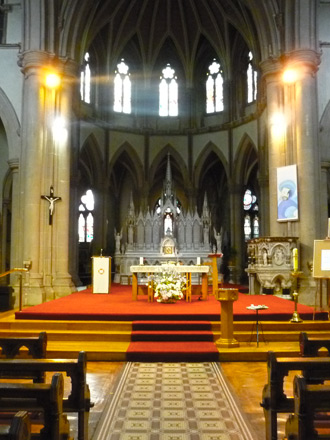
The
internal spatial arrangement and furnishings are also of high quality, in
particular the stained glass windows. Many of these are from the studio Lobin
of Tours and are of high quality, while those of the Irish stained glass master
Harry Clarke are of international cultural significance.
All
of these various strands of interest and built heritage can be said to combine
to make an historic place of regional significance.